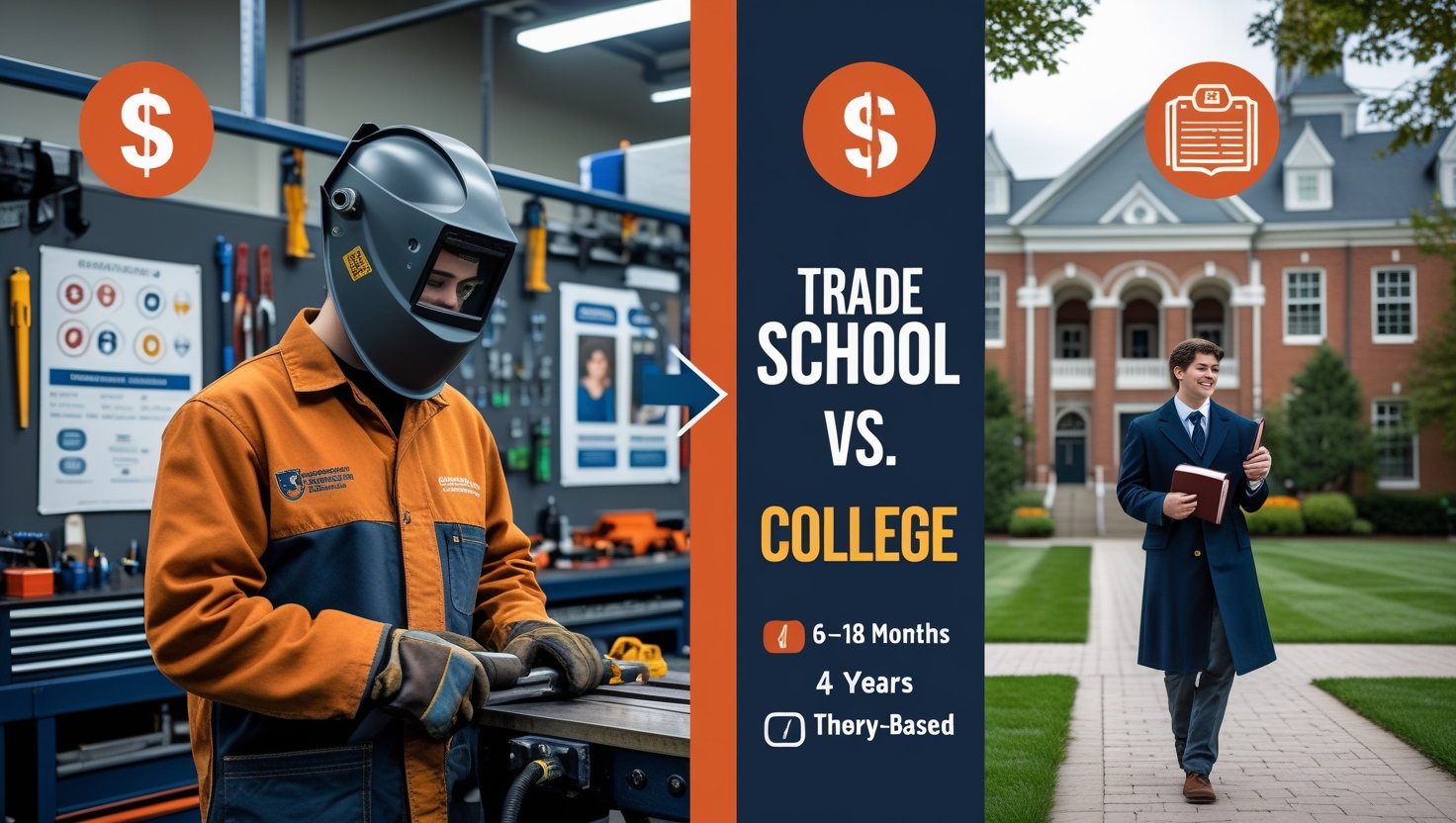
Today’s students have two major options when they complete their education: either attend a trade school or a traditional college. Both education systems have their unique approach and both have their pros and cons. Trade schools, also called vocational schools, are for students who want to get training in a specific skill or technical field, such as an electrician, plumber, welder, or medical technician. These programs last anywhere from 6 months to 2 years and focus on direct learning.
On the other hand, college education is more theoretical and academic. In college, students complete a 4-year bachelor’s degree program in which they study diverse subjects such as science, arts, business, or engineering. This route is for people who want to pursue corporate jobs or higher education.
Both these options directly influence the future career of the student. Therefore, it is important to understand which type of education is better for which person. Every student has different priorities; some want a quick job, some want a higher salary, and some want flexibility and career growth.
In this blog, we will talk in detail about the difference between trade school and college, the benefits and challenges of both, and how you can make better decisions according to your goals.
Duration and Cost: Time vs. Tuition:
When we look at the difference between trade school and college, the biggest factor is their duration and cost. Trade schools generally offer programs ranging from 6 months to 2 years that focus on specific skills and technical training. This means that students complete their education quickly and enter the job market. In contrast, it takes at least 4 years to obtain a bachelor’s degree in colleges, and it takes even more time if one wants to do master’s or higher studies.
Trade school is also quite affordable in terms of cost. The tuition fee of trade programs is much less than that of colleges, and students get jobs quickly, through which they recover their fees as well. The fees for college education can go up to lakhs, and often, students have to take student loans, which later become a huge burden to repay.
So, if a person wants to become a part of the workforce quickly and acquire skills without investing a lot of money, trade school can be a good option. But if someone’s goal is long-term academic or professional growth, it may be better to go to college.
Career Opportunities and Job Market Readiness:
Career opportunities are an important decision-making factor for everyone when choosing a trade school or college. Trade schools focus on practical skills and preparing professionals for specific industries such as electrician, mechanic, HVAC technician, or dental hygienist. These people enter the job market quickly because their training is directed at the skills employers need.
College graduates often work in a wider variety of fields, such as business, technology, education, or healthcare management. But it may take them a little longer to find a job because their education system is more theoretical and experience is less. Despite this, there are many fields where entry is not available without a college degree, such as engineering, law, or medicine.
The advantage of trade school students is that they are job-ready as soon as they complete their training, whereas college graduates often have to start with internships and entry-level jobs. Job market readiness is a strong point of trade schools, but college graduates have more long-term career flexibility and promotion opportunities.
The final decision depends on which field you want to go into and what kind of job environment you prefer, practical or corporate.
Earning Potential and Job Stability:
People often think a college degree means a higher salary, but that’s not always the case. Trade school graduates often make good money, especially in industries where the demand for skilled labor is high and the supply is low. For example, electricians, welders, and HVAC technicians often earn $50,000 to $60,000 starting, and their income increases with experience.
College graduates have greater long-term earning potential, especially if they work in high-demand fields such as IT, finance, or the medical field. But it takes time to build a career after completing their degree, and sometimes there is a financial burden due to student loans.
Job stability also relates to the field and demand. Skilled trades are often recession-proof as people always feel the need for plumbing, electricity, and basic repairs. On the other hand, some college degree jobs can become unstable due to automation and market changes.
If you want to start your career by earning money in the short term, then trade school can be beneficial, but if you are thinking about long-term stability and promotions, then a college degree can prove to be a good investment.
Learning Environment and Skill Development:
The learning environment of trade schools is very practical, where students are trained in real-life tasks rather than theory. Here, students learn through workshops, labs, and hands-on projects, with the advantage that they can go to any job site and start working immediately. This type of learning method is best for those who are more interested in learning by doing than in textbooks.
The learning environment of college is more academic and theory-based. Students attend lectures, do research assignments, and develop critical thinking. This approach is good for those who want to acquire broad knowledge and analytical skills. College also focuses on soft skills such as communication, leadership, and problem-solving that are required in many corporate jobs.
Skill development happens in both education systems, but the approach differs. Trade schools focus on specific skill sets while colleges take a broader perspective and provide development in multiple skill areas. Ultimately, it depends on your learning style and the type of education model that matches your career goal.
Conclusion:
Ultimately, the most important thing is that you choose a trade school or college according to your career goals, financial situation, and learning style. Every person’s path is different, and each route has its unique benefits and challenges. If you want to enter the job market quickly and get a skilled job with less investment, then a trade school may be the best option for you.
But if you are interested in academic knowledge, want long-term career growth, promotions, and flexible career options, then a college education can be more beneficial for your future. The purpose of this blog is that you understand both the options and make the right decision for yourself.
This decision should not be based on anyone else’s advice but should be based on your thinking, interest, and goals. Whether you choose a trade school or college, if you work with dedication, success will always be with you.
FAQs:
1. What is the main difference between trade school and college?
Trade school focuses on specific skills and hands-on training for technical jobs like electricians, welders, or medical technicians. These programs usually last between 6 months to 2 years. College, on the other hand, offers a 4-year academic degree with a focus on theoretical learning across a variety of subjects such as business, science, or the arts.
2. Is trade school more affordable than college?
Yes, trade schools are generally much cheaper than traditional colleges. Tuition fees are lower, and students typically enter the workforce quickly, allowing them to recover their investment sooner. College tuition can be very high, and many students take out loans, which can lead to long-term financial debt.
3. Who earns more: a trade school graduate or a college graduate?
In the short term, trade school graduates can earn good money, especially in high-demand skilled labor fields like HVAC or plumbing. However, college graduates often have higher long-term earning potential, particularly in fields like IT, finance, or healthcare, though it may take longer to reach that level.
4. How do the learning environments of trade schools and colleges differ?
Trade schools offer a practical, hands-on learning environment where students learn by doing. Colleges provide a more theoretical, academic setting with lectures, research, and written assignments. Trade school is ideal for those who prefer learning by doing, while college suits those who enjoy classroom learning and broader knowledge.
5. Do trade school students enter the job market faster than college students?
Yes, trade school students usually enter the workforce right after completing their training because they are job-ready with specific skills. College students may take longer, often starting with internships or entry-level positions, since their education is more theory-based and broad.